Transitioning to renewable energy generation requires substantial financial commitment and meticulous research. The market currently overflows with highly varied equipment, making the selection process incredibly complex for buyers who want maximum value. Evaluating technology demands a rigorous approach to technical specifications, manufacturing standards, and long term physical durability. Buyers frequently make decisions based solely on initial pricing, completely ignoring the structural integrity and long term generation capacity of the modules.
Understanding the intricate engineering behind photovoltaic technology empowers individuals to secure hardware that will operate flawlessly for decades. A thorough assessment prevents premature system failures, eliminates recurring maintenance expenses, and guarantees a consistent return on investment. This guide explores the fundamental parameters every buyer must scrutinize to ensure they procure premium grade equipment capable of withstanding extreme environmental conditions while delivering peak electrical output.
Decoding Tier 1 Rankings and Essential Global Certifications
Financial bankability often confuses buyers who mistake market rankings for direct guarantees of physical quality. The widely recognized Tier 1 classification strictly evaluates the financial stability of the manufacturing company and its acceptance by major banking institutions for large scale funding. While selecting a financially stable brand ensures the company will remain operational to honor future warranty claims, it does not confirm the individual module’s engineering excellence.
Buyers must shift their focus toward independent testing laboratories that issue internationally recognized certifications. The International Electrotechnical Commission provides the strictest testing protocols, specifically IEC 61215 for design qualification and IEC 61730 for strict safety compliance. Furthermore, buyers should mandate specialized certifications if they reside in specific environments. Agricultural installations require ammonia resistance certifications, whereas coastal properties demand rigorous salt mist corrosion testing.
Independent laboratories subject the modules to extreme mechanical loads, verifying their ability to handle heavy snow accumulation and high velocity wind pressures without suffering microscopic internal damage. Procuring equipment lacking these fundamental independent certifications introduces massive operational risks and potential electrical hazards into the property infrastructure. Real quality verification relies entirely on documented laboratory results rather than aggressive corporate marketing campaigns.
How Well the Panels Handle High Heat
Energy conversion efficiency directly dictates how much electricity a module can generate from the available sunlight within a restricted physical area. While higher efficiency ratings generally indicate superior silicon engineering, buyers must align these metrics with their specific energy consumption targets and available installation space. Standard polycrystalline options generally offer lower efficiency, whereas modern monocrystalline cells utilizing Passivated Emitter and Rear Cell technology easily exceed twenty one percent.
High efficiency modules become mandatory for properties with restricted roof dimensions to guarantee the system meets total energy demands. Beyond base efficiency, temperature tolerance plays an equally paramount role in sustained power generation. Solar cells naturally lose their ability to generate maximum electricity as surface temperatures escalate past standard laboratory testing conditions of twenty five degrees Celsius.
The temperature coefficient specifies the exact percentage of output lost for every single degree of temperature increase above this threshold. Premium equipment features a much lower temperature coefficient, ensuring the system continues to generate substantial power during scorching summer afternoons. Evaluating these specific thermal properties allows buyers to model realistic year round generation capabilities instead of relying on theoretical laboratory maximums.
Investigating Linear Degradation Rates and Warranty Clauses
All silicon based generation equipment naturally degrades, resulting in a gradual reduction of electrical output over an extended timeframe. Understanding and calculating this inevitable power loss separates high grade technology from substandard alternatives. Premium modules experience extremely low Light Induced Degradation during their first year of operation, followed by a linear annual degradation rate of less than half a percent. Conversely, budget alternatives often lose over two percent in the first year and continue to degrade rapidly.
Over a twenty five year projected lifespan, these fractional differences translate into massive deficits in total electricity production and financial savings. Buyers must carefully examine the manufacturer’s linear performance warranty to confirm guaranteed output levels for the end of the operational lifecycle. Top tier manufacturers confidently guarantee a minimum of eighty five percent of original power capacity after twenty five years of continuous operation. Securing original equipment directly impacts the validity of these warranties.
Engaging with reputable solar panel dealers in Lahore ensures that buyers receive authentic, non counterfeit modules backed by fully verified manufacturer warranties. Additionally, buyers should evaluate the separate product defect warranty, which covers flaws in manufacturing and materials. Leading brands now offer twenty five year defect coverage, providing complete peace of mind regarding structural longevity.
Conducting Physical Inspections for Manufacturing Anomalies
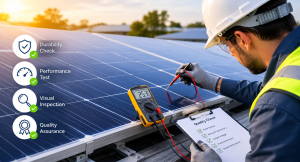
Theoretical specifications printed on technical sheets must precisely match the physical reality of the delivered hardware. Whenever possible, buyers should physically inspect the units before authorizing the final installation process. The exterior frame heavily dictates the structural integrity of the entire unit. Manufacturers construct premium frames from thick anodized aluminum, completely sealed with high grade industrial silicone to prevent moisture intrusion.
The front glass covering the delicate silicon cells must be highly tempered to withstand direct hail impacts and feature advanced anti reflective coatings to maximize light absorption. Visual inspections can quickly reveal poor manufacturing standards. Buyers should check for perfect cell alignment, uniform color distribution, and the complete absence of soldering debris. Discoloration or visible wiring inconsistencies indicate a severe lack of quality control during the factory assembly line.
Buyers should request electroluminescence imaging reports from the supplier. This specialized imaging functions like an x-ray, exposing microscopic internal fractures known as micro cracks that remain completely invisible to the human eye. Confirming the absence of internal mechanical damage guarantees that the equipment will perform precisely as engineered without suffering premature power drops.
Inspecting the Panel’s Backing and Wiring
Components positioned on the underside of the module rarely receive attention, yet they function as the primary defense against electrical shorts and environmental degradation. The polymer backsheet protects the internal circuitry from continuous ultraviolet exposure, humidity, and extreme temperature fluctuations. Inferior backsheet materials rapidly break down, leading to severe chalking and dangerous delamination within just a few years.
Once the backsheet barrier fails, moisture immediately penetrates the live electrical components, causing catastrophic short circuits and permanent system failure. Buyers must verify that the manufacturer utilizes complex fluoropolymer materials engineered for maximum long term weather resistance. Similarly, the junction box housing the primary electrical connections requires strict evaluation.
Premium junction boxes carry an IP68 waterproof rating, ensuring complete isolation from heavy rainfalls and fine dust particles. These boxes also contain critical bypass diodes, which redirect electrical current when specific sections of the module experience shading from passing clouds or nearby trees. High quality diodes prevent the localized overheating phenomenon known as hot spots, which can permanently destroy the silicon cells. Evaluating the thickness and copper density of the attached output cables provides additional verification of the manufacturer’s commitment to electrical safety.
Checking How the Panels Actually Perform
Laboratory testing provides necessary baseline figures, but empirical field data reveals the true operational capability of the hardware. Buyers should actively request specific case studies and historical generation logs from existing installations operating in similar geographical climates. Professional monitoring platforms continuously track energy yields, providing transparent data that strips away inflated marketing claims.
Analyzing how specific equipment performs during extended overcast periods or extreme heat waves provides highly accurate expectations for daily power production. Furthermore, consulting independent engineers or reviewing third party flash test data helps verify that the modules produce the exact wattage stated on the factory label.
Manufacturers confident in their engineering readily supply detailed production simulations and verified historical logs. Ignoring this wealth of real world data leaves buyers highly vulnerable to purchasing systems that excel in controlled environments but drastically underperform in practical application. Taking the necessary time to review longitudinal performance records ultimately guarantees a vastly superior and far more reliable financial return.
Elevating Energy Independence with Expert Engineering
Sourcing premium components represents only the initial phase of deploying a resilient generation infrastructure. The ultimate reliability of the entire grid depends heavily on the precision of the final engineering and integration process. Connecting sophisticated technology requires meticulous calculations, exact load balancing, and strict adherence to modern electrical codes.
Divine Solutions excels in delivering flawless integration services that maximize the operational lifespan of high grade equipment. Their engineering teams focus intensely on custom system architecture, ensuring that every mounting structure and electrical conduit meets rigorous safety standards. By avoiding generic installation templates, they tailor the entire setup to perfectly match the specific structural and energetic requirements of the property.
Clients receive a fully optimized infrastructure designed to withstand harsh weather conditions while extracting maximum energy from the available sunlight. This uncompromising approach eliminates the severe risks associated with poor wiring practices and substandard mounting procedures. Divine Solutions provides the necessary technical mastery to transform individual components into a cohesive, highly efficient power plant, guaranteeing decades of secure, uninterrupted energy independence.
Wrapping Up
The transition toward sustainable energy mandates a highly analytical approach to equipment procurement. Verifying manufacturing standards requires buyers to look far beyond simple brand recognition and aggressive pricing models. A rigorous evaluation of technical certifications, mechanical durability, and long term warranties ensures the selection of hardware capable of surviving decades of continuous exposure. Neglecting these fundamental parameters frequently results in early component failure, massive repair expenses, and severely compromised power generation.
Physical construction heavily influences the long term viability of the entire infrastructure. Inspecting the structural integrity of the outer frame, the clarity of the protective glass, and the resilience of polymer backsheets prevents catastrophic moisture intrusion. Taking the time to demand factory imaging reports to rule out microscopic internal fractures further solidifies the investment. This level of extreme scrutiny guarantees that the deployed hardware will maintain peak electrical output despite constant environmental stressors.
Establishing a truly resilient solar panel network relies on pairing superior hardware with flawless engineering practices. Buyers must maintain absolute vigilance throughout the selection process, demanding objective testing data and verifiable generation logs from their suppliers. Securing meticulously engineered equipment guarantees profound reductions in monthly utility expenses and long term energy security. Diligent research and strict verification methodologies remain the most powerful tools for maximizing the overall success of this substantial financial commitment.