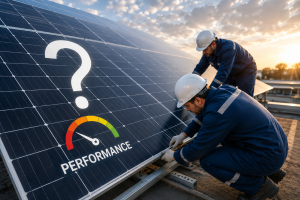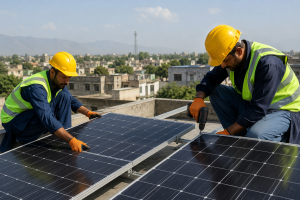
Urban rooftop solar arrays face distinct environmental stressors within the Punjab region. High velocity windstorms during the pre monsoon season create significant uplift forces on elevated mounting frames. When an engineering team ignores localized wind load dynamics, structural failures manifest as sheared fasteners or warped framing profiles. Standard mounting structures often lack the necessary geometric rigidity to counter wind speeds exceeding one hundred and thirty kilometers per hour. A professional solar installation utilizes heavy duty hot dip galvanized steel or high tensile anodized aluminum profiles engineered specifically to withstand these environmental pressures.
Mechanical degradation extends beyond simple structural failure to encompass subtle micro cracking within the silicon cells. Constant wind induced vibration causes microscopic fractures that gradually isolate sections of the photovoltaic panel, reducing energy output permanently. Unplanned downtime caused by compromised framing components disrupts industrial operations and inflates operational expenses. Proper installation methodology demands structural ballast weight calculations, precision chemical anchors injected deep into concrete slabs, and a strict layout that prevents roof membrane penetration while ensuring wind deflection optimization.
Component Traceability and Tier1 Semiconductor Standards
Navigating the dense commercial landscape requires separating high efficiency hardware from sub standard replicates lacking verifiable manufacturing origin. Discerning property owners who seek the best solar company in lahore evaluate engineering documentation rather than generic promotional brochures. True quality assurance relies on matching every individual serial number with factory direct flash test datasets. This rigorous approach confirms that the modules perform to their full nameplate capacity under localized conditions. High caliber implementation firms source materials exclusively from recognized Tier 1 global manufacturers, ensuring the presence of advanced passivated emitter rear cell chemistry.
Premium photovoltaic modules utilize specialized N-type tunnel oxide passivated contact architectures. This advanced semiconductor engineering limits initial light induced degradation and minimizes annual performance degression over a twenty five year period. Lower grade panels often suffer from severe potential induced degradation, which rapidly diminishes voltage output when exposed to persistent atmospheric humidity. Demanding comprehensive bills of lading and official customs clearance documentation shields industrial and residential consumers from grey market components that exhibit premature cell degradation.
Factory certified flash testing represents a critical metric for verifying nominal power output tolerances. These tests evaluate individual panel performance under standard test conditions, ensuring that power variance remains strictly positive. Inferior product batches frequently demonstrate wide power variations, resulting in significant mismatch losses when wired in series strings. Eliminating these electrical variances requires an installer who performs pre installation testing and maintains transparent supply chains with global tier-one fabrication plants.
Systemic Net Metering and Regulatory Compliance Protocols
Integrating a renewable power plant with the local electrical grid requires absolute alignment with complex regulatory frameworks. The execution of a successful grid tied system hinges on obtaining net metering authorization from the National Electric Power Regulatory Authority. This procedural workflow involves multi stage approvals, technical feasibility studies by the power distribution utility, and the installation of an approved bidirectional meter. An experienced technical partner navigates these bureaucratic steps seamlessly, avoiding lengthy commissioning delays that leave capital investments underutilized.
Technical errors during the distribution utility inspection can jeopardize the entire project timeline. Inspectors scrutinize the isolation mechanisms, earth loop impedance values, and anti islanding parameters of the system. If the protective relays fail to isolate the solar generation system during grid outages, utility maintenance personnel face severe safety hazards. Ensuring full safety compliance requires installing certified manual disconnect switches alongside automated protective logic embedded within the system architecture.
The financial viability of urban solar arrays depends directly on the swift execution of this regulatory clearance. Every week spent waiting for bidirectional meter integration represents a period of unmonitored power export loss. Competent engineering teams manage this process proactively by preparing rigorous single line diagrams, earthing certificates, and load flow analysis documents weeks before physical installation finishes. This strategic planning compresses the regulatory timeline, enabling rapid transition to active grid monetization.
Inverter Topology and Thermal Management Systems
Solar inverters serve as the core intelligence of the power infrastructure, converting raw direct current into stable alternating current. Selecting the proper inverter topology determines how effectively the system handles localized shading and extreme summer ambient temperatures. String inverters equipped with multiple maximum power point tracking channels optimize generation across diverse roof orientations. This configuration prevents a single shaded panel from dragging down the performance of an entire electrical string, maximizing cumulative energy collection.
High ambient heat introduces severe thermal operational challenges for electronic power components in Punjab. When ambient air temperatures surpass forty five degrees Celsius, standard inverters often trigger automatic thermal derating to protect internal circuitry. This defensive mechanism limits power output precisely when solar irradiance reaches peak levels, leading to substantial energy loss. High tier engineering designs utilize inverters with robust passive or active smart cooling convection systems, maintaining maximum output even during prolonged heat waves.
Enclosure protection ratings form another critical selection parameter for regional installations. Airborne dust and heavy monsoon moisture can penetrate inadequately sealed units, causing internal short circuits and permanent component failure. Securing an ingress protection rating of IP66 ensures that the internal processing boards remain completely isolated from environmental contamination. Investing in superior enclosure engineering minimizes long term maintenance overhead and avoids the extensive expenses associated with premature inverter replacement.
Quantifying Financial Payback and Performance Degression Metrics
Evaluating a solar investment requires moving decimal points beyond initial capital cost comparisons toward a comprehensive total cost of ownership analysis. Financial projections must incorporate realistic annual performance degression rates, which typically average zero point five percent for premium Tier 1 silicon modules. Sub standard installations often experience accelerated degradation exceeding two percent annually due to moisture ingress and ethylene vinyl acetate yellowing. Accurate financial modeling must account for these real world performance shifts to protect investor capital.
Levelized cost of energy serves as the ultimate metric for comparing solar deployment viability against conventional grid tariffs. Achieving a highly favorable levelized cost requires maximizing system uptime and optimizing individual component efficiencies over multiple decades. When structural or electrical components degrade prematurely, the resulting maintenance interventions degrade the overall return on investment. Professional system designers use advanced software simulations to predict exact shading impacts and optimize cable sizing, restricting voltage drops to under one percent.
Capital optimization also relies on choosing matching battery storage solutions for hybrid systems. Energy storage configurations require careful depth of discharge management to ensure the longevity of lithium iron phosphate or lead acid chemistries. Selecting an installer who calculates exact daily load profiles prevents over sizing or under sizing the storage bank. This precise sizing methodology protects the batteries from deep cyclical strain, expanding their operational lifetime and optimizing the payback period.
Post Commissioning Maintenance and Quality Assurance Audits
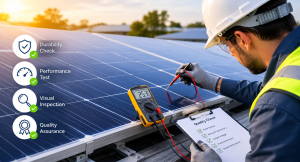
Long term operational reliability depends on executing standardized post commissioning maintenance protocols rather than relying on reactive troubleshooting. Accumulations of airborne particulate matter and industrial soot on panel surfaces create significant soil losses, reducing total generation by up to twenty percent if left uncleaned. Automated or scheduled manual cleaning cycles using demineralized water protect the anti reflective glass coating from abrasive scratching. Implementing these routine practices ensures consistent light transmission and peak energy conversion.
Advanced quality assurance involves periodic thermal imaging audits conducted via handheld infrared sensors. These thermal scans identify hidden electrical anomalies, such as failing bypass diodes or high resistance cable connections, before they develop into hazardous fire risks. Unresolved hot spots degrade nearby cells rapidly, leading to expensive localized panel replacements and extended system isolation. Proactive engineering firms include regular infrared imaging and string level current voltage curve tracing within their standard service packages.
Remote monitoring platforms represent the final tier of comprehensive operational oversight. Cloud based telemetry systems track daily production metrics and broadcast instant alerts if component performance deviates from baseline projections. This real world data collection enables technical teams to identify and remedy string level faults immediately, reducing production losses. Prioritizing an engineering partner who offers integrated cellular or Wi-Fi data tracking secures the continuous operational integrity of the entire renewable energy asset.
Specialized Engineering Capabilities for Urban Photovoltaic Integration
Exceptional renewable execution demands an alignment of specialized engineering design and direct access to premium global supply chains. A premier solar installation service operating provides comprehensive engineering, procurement, and construction services tailored to the specific climatic conditions of Punjab. This specialized group deploys top tier global modules from suppliers. This extensive hardware access ensures that each structural design features the ideal semiconductor configuration for maximized urban energy generation.
The integration process incorporates high capacity electronic management systems utilizing elite inverter solutions. This vast technical matrix allows engineers to build highly customized energy plants, integrating specialized battery storage setups that deliver seamless backup power during grid instability. Every project undergoes structural weight distribution reviews and precise wind resilience planning, ensuring complete mechanical endurance over a twenty five year lifespan.
Beyond hardware deployment, the internal technical team handles the complete regulatory process required for successful net metering implementation. This includes preparing professional single line diagrams, conducting grid connection feasibility reviews, and managing all administrative interactions with the power distribution company. By supervising every phase from initial shadow analysis to final grid connection, this expert group guarantees optimal generation efficiency and rapid financial payback for residential, commercial, and industrial property owners.
FAQ’s
What specific criteria define a BloombergNEF Tier-1 solar panel rating?
A Tier 1 rating signifies that a panel manufacturer has supplied independent, bank financed projects over the past two years. This designation focuses strictly on financial bankability and manufacturing stability rather than direct product quality, though Tier 1 companies generally utilize advanced automated fabrication lines and superior quality control protocols.
How does high ambient temperature impact total photovoltaic power generation?
Photovoltaic modules experience a drop in efficiency as surface temperatures climb, a phenomenon measured by the temperature coefficient. When panel temperatures exceed twenty five degrees Celsius, power output drops by approximately zero point three five to zero point four percent per degree, making proper airflow and elevated mounting critical for hot climates.
Why is structural wind load modeling necessary for urban rooftop solar installations?
Rooftops encounter severe wind amplification and turbulences during seasonal storms. Wind load modeling ensures that the structural mounting profiles, tilt angles, and chemical anchors possess sufficient mechanical strength to resist uplift forces, preventing the arrays from detaching and causing catastrophic structural roof damage.
What is the difference between N-type TOPCon and traditional P-type Mono PERC panels?
N-type TOPCon modules use phosphorus doped silicon wafers, which offer superior resistance to light-induced degradation and a better temperature coefficient compared to boron doped P-type Mono-PERC modules. This advanced chemical composition ensures higher energy conversion efficiency and slower power degradation over decades.
How long does the regulatory process for net metering activation typically require?
The complete net metering authorization timeline generally spans six to eight weeks, depending on utility efficiency. This multi phase procedure includes initial site inspection, technical feasibility validation by the distribution company, NEPRA license issuance, and the final physical mounting of the bidirectional meter.
What role do maximum power point trackers perform within a solar inverter?
Maximum power point trackers constantly adjust electrical voltage and current to ensure the solar array operates at its peak possible power output under changing sunlight conditions. Inverters with multiple tracking channels allow distinct sub arrays to perform independently, minimizing efficiency losses caused by partial shading or unequal string lengths.
What parameters determine whether a property requires string or micro-inverter topology?
String inverters represent the ideal choice for large, unshaded roof spaces where panels share uniform orientations. Properties experiencing complex, multi directional roof layouts or persistent shading from nearby trees or structures benefit from localized optimization, though high quality multi MPPT string systems handle mild shading effectively with lower capital investment.
How does soil accumulation alter the long-term return on investment for solar plants?
Thick layers of dust, airborne pollution, and industrial soot block solar irradiance from reaching the internal silicon cells. This accumulation can reduce immediate power yields by fifteen to twenty five percent, extending the financial payback period unless regular, non abrasive cleaning schedules are maintained.
What specific safety mechanisms protect utility workers during localized grid outages?
Solar inverters feature mandatory anti islanding protection that instantly shuts down power export when the main utility grid fails. This safety automation prevents the solar array from feeding high voltage electricity back into dead utility lines, protecting maintenance crews who are working to repair grid infrastructure.
What standard warranties should accompany a professional commercial solar implementation?
A tier one solar asset carries two distinct warranties, including a twelve to fifteen year mechanical product warranty covering physical defects and a twenty five year linear performance warranty guaranteeing that power output remains above eighty percent of nominal capacity by year twenty five.
Final Remarks
Transitioning to localized renewable generation offers a definitive path toward energy independence and long term financial stability. Achieving these practical objectives requires a commitment to rigorous engineering standards, certified component sourcing, and proactive maintenance planning. Property owners who look past superficial marketing claims and prioritize structural integrity and component traceability secure a highly dependable asset that yields predictable energy outputs for decades.
Implementing a robust solar infrastructure requires deep familiarity with local regulatory policies and utility grid specifications. The successful integration of an optimized net metering framework serves as the foundation for modern urban energy transformation, turning standard consumers into active energy producers. Selecting an engineering group capable of executing these intricate technical requirements ensures that the installed system delivers high efficiency and minimal operational downtime.
The long term value of a photovoltaic installation rests on the precision of its initial deployment and the quality of its internal electronics. By focusing on Tier 1 hardware authenticity, specialized wind load modeling, and sophisticated thermal dissipation topologies, consumers protect their capital from premature mechanical